



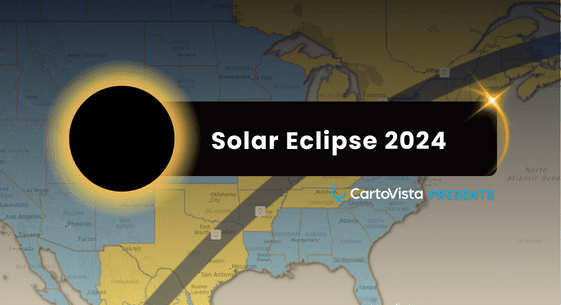

Path of the Solar Eclipse
Here at CartoVista, we have created an interactive map that shows you the path of the moon’s shadow as it glides across North America.
Types of Solar Eclipses
A solar eclipse occurs when the Moon passes between the Earth and the Sun, blocking all or part of the Sun’s light from reaching the Earth. There are three main types of solar eclipses:
-
Total Solar Eclipse: This occurs when the Moon completely covers the Sun, casting a shadow on Earth. During a total solar eclipse, the sky becomes dark as if it were nighttime, and the Sun’s corona-the outer atmosphere-becomes visible. Total solar eclipses are relatively rare and can only be observed from specific locations on Earth.
-
Partial Solar Eclipse: This occurs when only a part of the Sun is obscured by the Moon, resulting in a partial blocking of sunlight. The extent of the eclipse depends on the viewer’s location. Partial solar eclipses are more common than total eclipses and can be observed from a larger area.
-
Annular Solar Eclipse: This occurs when the Moon is too far away from the Earth to completely cover the Sun’s disk. As a result, a ring of sunlight remains visible around the Moon, creating what’s known as a “ring of fire” effect. Annular eclipses happen when the Moon is near its farthest point from Earth in its orbit.
Total Solar Eclipse in the United States
Here are some of the larger American cities that will experience a total solar eclipse:
- Dallas, Texas
- Little Rock, Arkansas
- Indianapolis, Indiana
- Cleveland, Ohio
- Buffalo, New York
Total Solar Eclipse in Canada
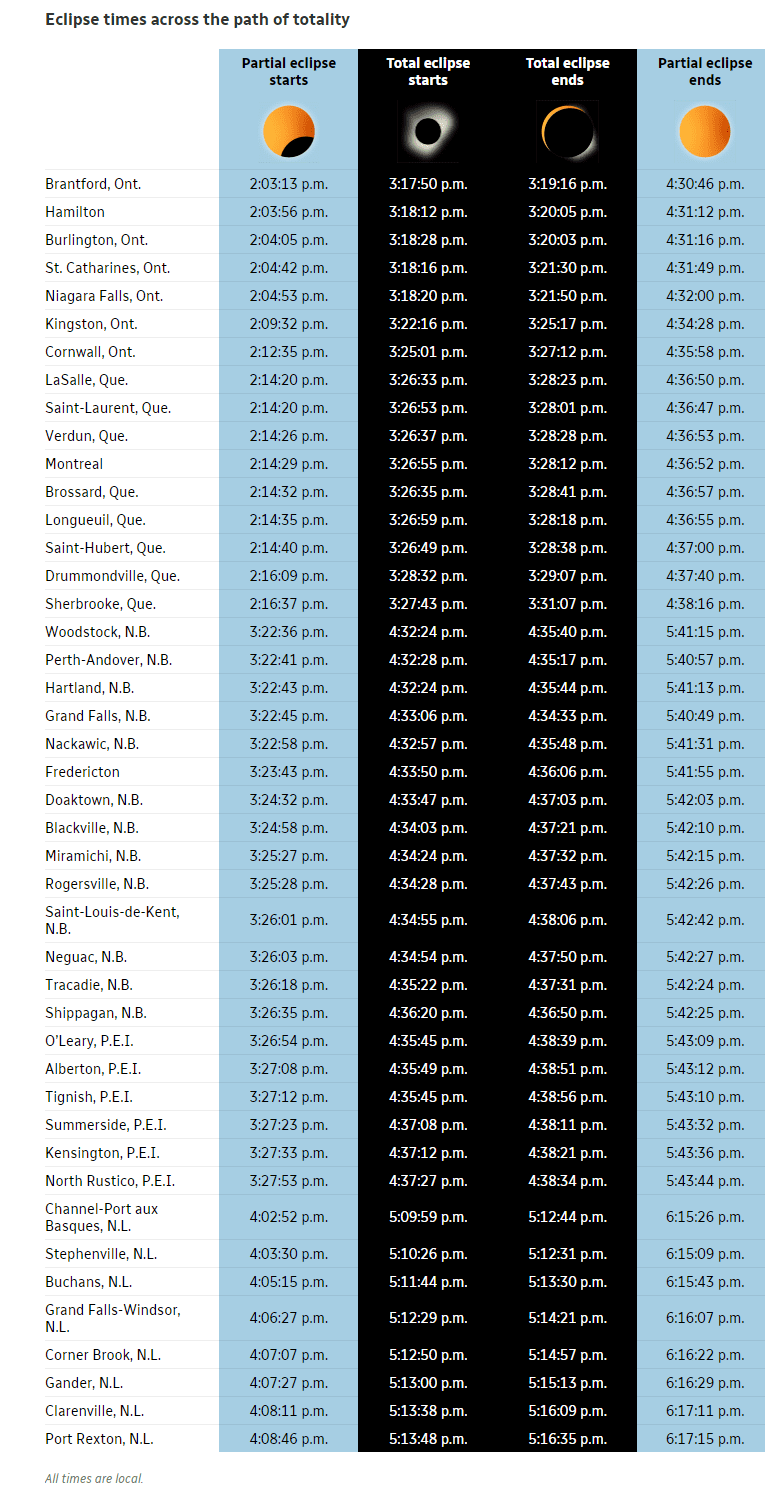
CBC has compiled an excellent dataset that shows the eclipse timings across multiple Canadian cities. Check it out below:
Here’s How To Watch the Solar Eclipse Safely
Heading out to view the eclipse?
The most critical aspect of witnessing a solar eclipse is protecting your eyes. Avoid looking directly at the Sun without appropriate eye protection. Use solar viewing glasses or handheld solar viewers certified to ISO 12312-2 standards.
If you’re near the path of this eclipse, you shouldn’t miss out on the chance to experience this rare celestial event. The next solar eclipse across Canada and the United States will be 20 years later, on Aug 23, 2044.